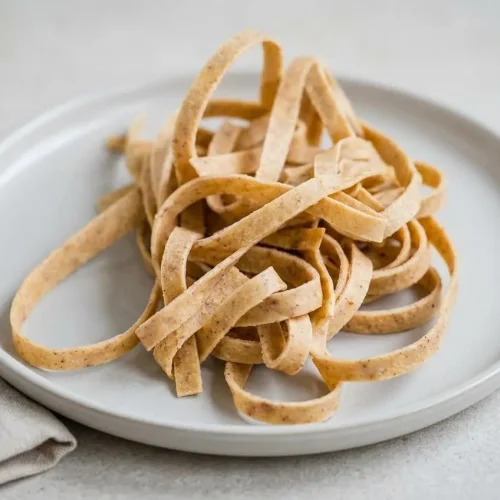
Keto Pasta

This homemade keto pasta offers a soft, pliable texture perfect for your favorite low-carb sauces. Made with cream cheese, eggs, and psyllium husk, it's baked into sheets and sliced, not boiled, for an ideal al-dente bite.
Equipment
- Food Processor
- Pasta Roller
Ingredients
- 4 eggs (room temperature)
- 150 g cream cheese
- ½ teaspoon salt flakes
- 1 teaspoon apple cider vinegar
- 2 ½ tablespoons psyllium husk powder (35g)
Instructions
Conventional Method
- Heat the oven to 150 °C/170 °C/300 °F and set out a large baking tray with baking paper ready. The pasta bakes quickly, so having the tray prepared makes it easier to spread the sticky dough before it starts to set.
- Add the eggs, cream cheese, salt flakes, apple cider vinegar, and psyllium husk powder to a food processor, then pulse until smooth and thick. The mixture should look like a sticky paste rather than traditional pasta dough, and resting it for 5 minutes helps the psyllium fully absorb moisture.
- Divide the mixture in half and spread one portion over a large sheet of baking paper with a silicone spatula. It will feel pasty and tacky, which is exactly right.
- Place a second sheet of baking paper on top and roll the dough into a rectangle about 20 cm x 40 cm and 1 to 2 mm thick, then transfer it to the tray with the top paper still in place. The thinner you roll it, the more delicate and pasta-like the final texture will be.
- Repeat with the remaining dough so you have two thin sheets ready to bake. Perfect edges do not matter here, but an even thickness does.
- Bake for 6 to 8 minutes, then remove the top sheet of baking paper and let the pasta cool on the tray for 1 to 2 minutes. The sheet is ready when it feels set and dry to the touch but still bends without cracking.
- Roll each sheet up from the short end and slice into ribbons with a sharp knife, or use a pasta cutter with a fettuccine setting. If the sheet is still too hot, it tends to squash rather than roll cleanly.
- Warm the cut pasta by tossing it with hot sauce during the last couple of minutes of cooking. Do not boil it in water, or the texture can soften too much and lose its shape.
Thermomix Method
- Place all the ingredients in the mixer and blend for 20 seconds on speed 5. The finished mixture should be thick, smooth, and sticky.
- Let the mixture rest for 5 minutes before rolling and baking it the same way as the conventional method. The short rest gives the psyllium time to firm up the dough so it spreads and slices more neatly.
Air Fryer Method
- Prepare the dough the same way, then roll it between baking paper sheets into portions that fit your air fryer basket or tray. Plan on working in two or more batches if needed so the sheets stay thin and even.
- Air fry at 150 °C for 4 to 5 minutes, then cool briefly before rolling and slicing into ribbons. The pasta should feel set on the surface while staying flexible enough to curl without breaking.
Notes
Troubleshooting Tip: If your pasta turns purple or gray, it's likely due to the brand of psyllium husk powder. The color is harmless, but switching brands usually prevents it.
Texture Tip: For a more neutral, less 'eggy' flavor, be sure to use room temperature eggs and roll the dough very thin.
Serving Tip: This pasta is delicate. Avoid boiling it in water. Instead, gently toss it in warm sauce for a minute or two just before serving to heat it through without it falling apart.
Storage: Keep leftover baked pasta sheets stored flat with parchment paper between layers. If you've already cut it into noodles, store them in a well-sealed container in the refrigerator.
Nutrition information is an estimate based on common ingredients and serving sizes. Values may vary depending on brands, portions, and substitutions.